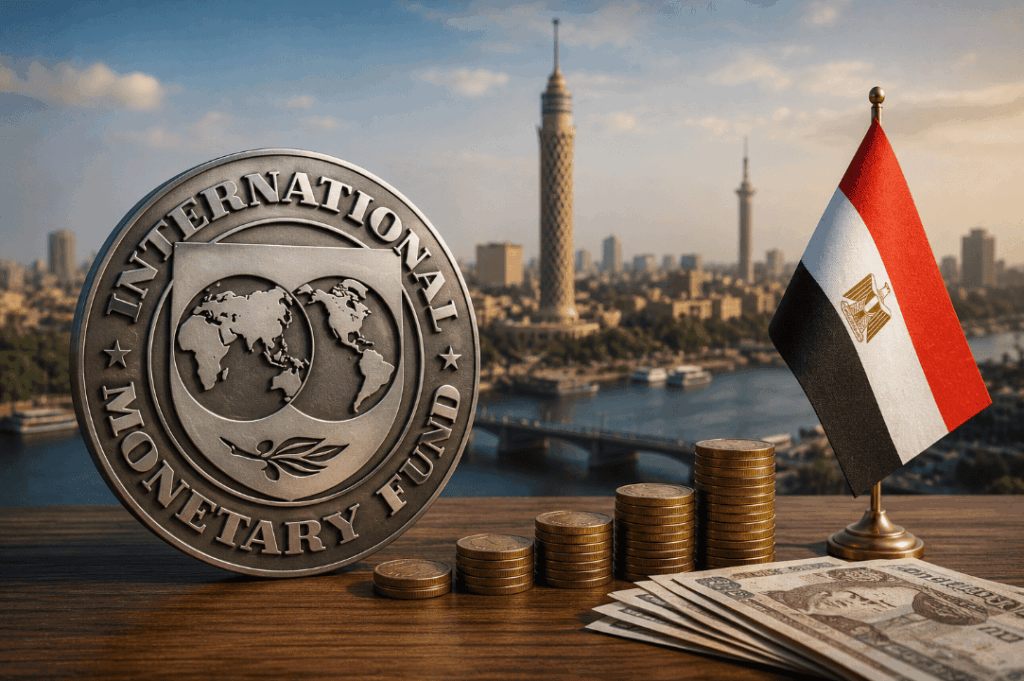
Egypt has taken another important step in its economic reform journey after reaching a staff-level agreement with the International Monetary Fund on the latest reviews of its financing programs.
The agreement covers the seventh review under the Extended Fund Facility and the second review under the Resilience and Sustainability Facility. Once approved by the IMF Executive Board, it could open the door to about $1.6 billion in new financing, giving Egypt fresh support at a time when the country is working to protect growth, control inflation and strengthen investor confidence.
IMF Deal Signals Confidence in Egypt’s Reform Path
The IMF’s latest assessment points to continued progress in Egypt’s reform agenda despite a difficult external environment. The country has faced pressure from regional instability, global price shocks and exchange-rate challenges, yet the economy has shown stronger-than-expected resilience.
According to the IMF, Egypt’s real GDP growth reached 5% in the third quarter, while growth for the first nine months of the fiscal year stood at 5.2%. The Fund also noted that international reserves remained broadly stable by the end of March 2026, helped by renewed portfolio inflows that supported the exchange rate after earlier periods of pressure.
Fiscal indicators also moved in a positive direction. Egypt exceeded its targets for both the primary balance and tax revenues by the end of March, a development that strengthens the government’s plan to bring public debt onto a more sustainable path.
The primary surplus is expected to rise from 4.8% of GDP in FY2025/26 to 5% in FY2026/27. At the same time, Egypt’s tax-to-GDP ratio is projected to increase by 1.2 percentage points this year, reflecting efforts to improve domestic revenue collection without relying only on borrowing.
Growth Momentum Remains Strong, but Risks Have Not Disappeared
While the agreement marks a positive signal for Egypt’s economy, the IMF also made clear that challenges remain. Inflation is still one of the most sensitive issues. Headline urban inflation reached 14.6% in May and is expected to climb to 15.8% by the end of the fiscal year.
The Fund emphasized that Egypt will need to preserve exchange-rate flexibility, improve debt management and continue structural reforms that allow the private sector to play a larger role in driving growth.
A key part of that agenda is the implementation of Egypt’s State Ownership Policy, which is designed to reduce the state’s footprint in selected sectors, improve the investment climate and create more room for private companies. If carried out effectively, the policy could help attract investment, support job creation and make economic growth less dependent on public spending.
The latest staff-level agreement therefore represents more than a financing milestone. It is also a signal that Egypt’s reform program remains under close international watch, with future progress likely to depend on how consistently the country can balance fiscal discipline, social protection and private-sector expansion.
For Egypt, the next major step is approval by the IMF Executive Board. If that happens, the new funding would provide additional breathing space while the government continues its wider effort to stabilize the economy and build a stronger foundation for long-term growth.