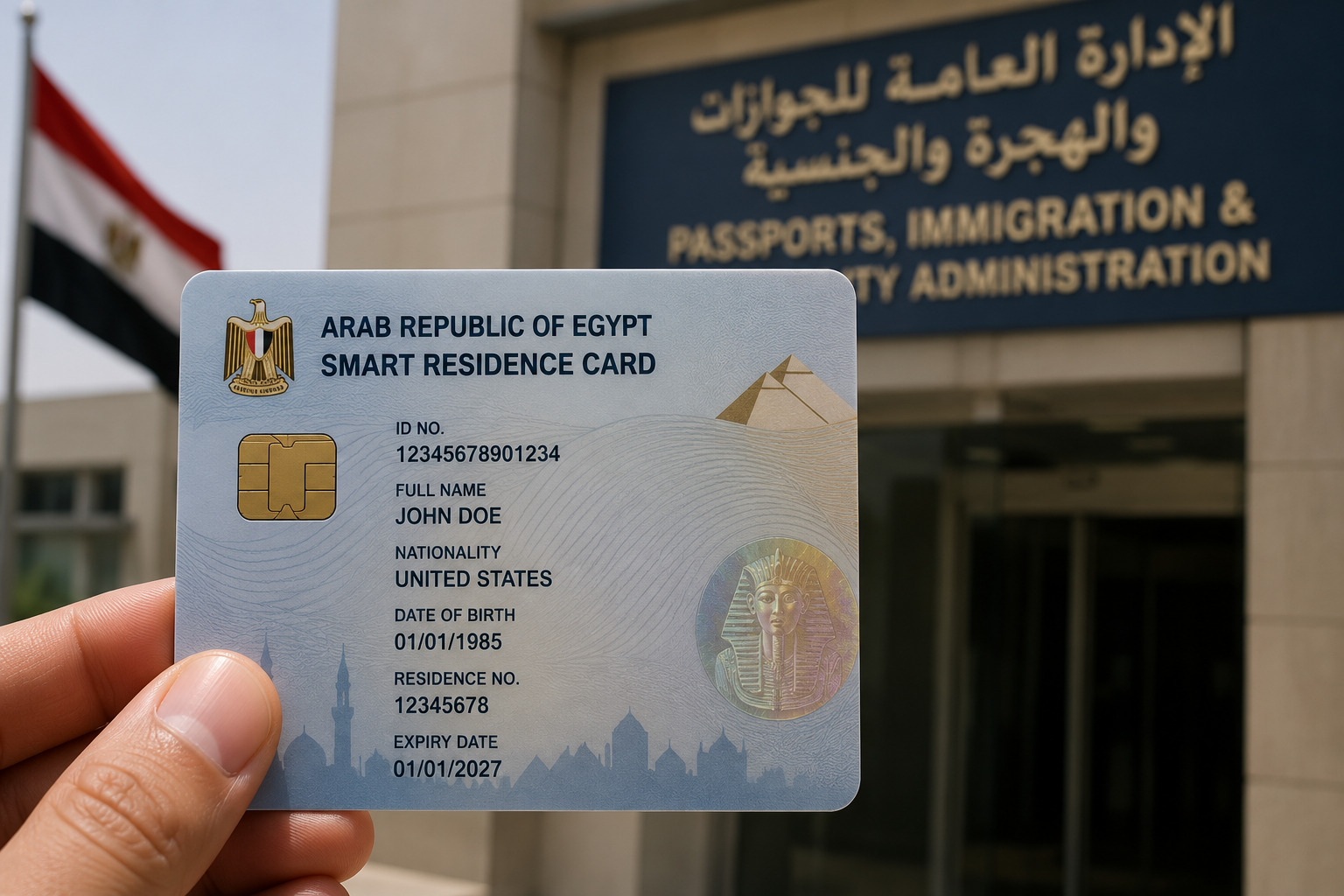
Egyptian authorities have urged all foreign nationals living in the country to regularize their residency status and obtain the newly introduced smart residency cards.
The move is part of a broader government effort to organize the legal status of foreigners in Egypt, improve official data systems, and ensure that residents can continue accessing public services without disruption.
According to the announcement, foreign residents are being asked to visit the General Directorate of Passports, Immigration and Nationality to renew their residency permits and receive the new smart cards. Officials said that state institutions will only provide services to foreigners who hold valid residency documents or official exemption cards.
The new requirement also applies to foreign nationals who are exempt from paying residency fees. These residents must still register their information and obtain exemption cards from the relevant authorities.
The smart residency cards are expected to become necessary for dealing with government institutions and accessing key services, including healthcare, education, banking, and administrative procedures.
Egypt has been tightening residency rules since 2023, when the government introduced measures requiring foreigners with irregular status to legalize their stay by paying administrative fees and submitting proof of an Egyptian host. Several grace periods were later granted to give residents more time to complete the process.
The policy comes as Egypt continues to host a large foreign population, including refugees, migrants, and expatriates from across the region. International Organization for Migration estimates cited by Ahram Online say that around 9.1 million foreign nationals from 133 countries currently live in Egypt, with large communities from Sudan, Syria, Yemen, and Libya.
The number of foreign residents has increased significantly since the outbreak of the Sudan war in April 2023, which pushed many displaced people to seek safety in Egypt.
Officials say the latest measures are intended to make residency procedures more efficient, strengthen data collection, and reduce pressure on public services at a time when the country is facing economic challenges.